
Reliable performance of materials is very important for safe and successful application any industrial process. Materials for a given application or equipment are selected for their required material properties, low initial capital investment, and minimum maintenance. Changes in the process parameters to improve products can often lead to higher corrosion susceptibilities of the plant materials.
The Corrosion and Materials Chemistry Research Laboratory (CMCRL) at the Georgia Institute of Technology, which is also associated with the Renewable Bioproducts Institute (RBI) have facilities to help industry with material selection and corrosion testing. Analytical and characterization tools needed for corrosion research are either available in our laboratory or as user facility at Georgia Tech.
CMCRL Equipment and Testing Capabilities
Here is a partial list of equipment and test facilities of the CMCRL at Georgia Tech:
1. General Corrosion Tests (Room temperature up to 200oC)
2. Electrochemical Tests for general corrosion and localized corrosion:
a. Potentiodynamic Polarization, Electrochemical Impedance Spectroscopy (EIS), Cyclic Voltammetery
b. Electrochemical tests at high temperatures and pressure (up to 300oC in autoclaves)
3. Erosion Corrosion – Rotating Cylinder Tests
4. Stress Corrosion Cracking and Corrosion Fatigue Testing
a. Slow Strain Rate Tests for stress corrosion cracking susceptibility of alloys at temperatures up to 200oC in corrosive environments, and 350°C in pure water.
b. Corrosion Fatigue test facility (MTS Model 810 machine with Teststar II® control system with environmental chamber) for crack growth and endurance limit studyin corrosive environments
5. High Temperature Gaseous Corrosion (Oxidation/Sulfidation Tests of Metallic Alloys)
a. Single and mixed gases over a range of temperatures, cyclic gases, and cyclic temperature capabilities (up to 1100°C)
b. Thermogravimetric microbalances for high temperature gaseous corrosion testing
6. Molten Salt Corrosion Tests, especially halide salts for nuclear applications and concentrated solar power applications
7. Fog Chamber Tests (ASTM B117 or equivalent)
8. Equipment for heat treatment, Metallography, Microhardness Measurements, and Image Analysis
9. Failure Analysis
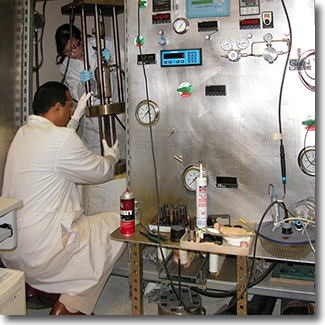
Slow strain rate rig with recirculation loop autoclave for stress corrosion cracking tests in boiler environments
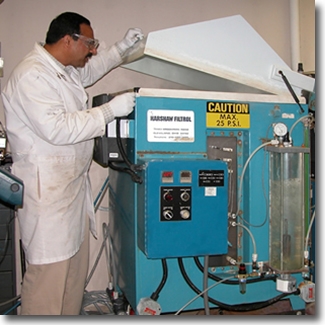
Salt fog chamber for atmospheric corrosion tests
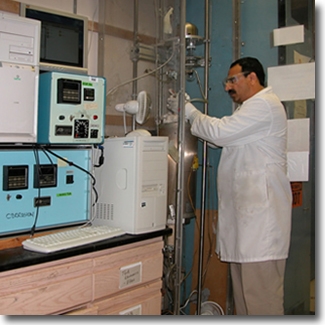
Thermal balance for high temperature gaseous corrosion test
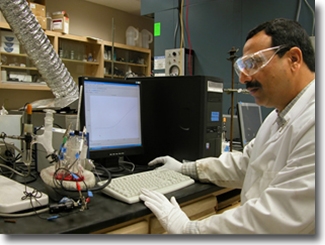
Electrochemical tests for corrosion
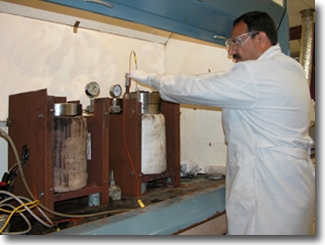
Autoclaves for high temperature high pressure corrosion tests
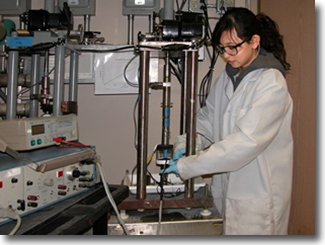
Slow strain rate rigs for stress corrosion cracking
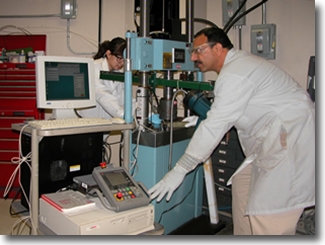
MTS for corrosion fatigue and mechanical behavior tests
Contact
Contact Information
Preet M. Singh
Professor
Phone: 404-894-6641
Email: preet.singh@mse.gatech.edu
Jamshad Mahmood
Mechanical Engineer II
Phone: 404-894-6647
Email: jamshad.mahmood@rbi.gatech.edu
To Request Testing
- Send e-mail to preet.singh@rbi.gatech.edu with details regarding the nature of the request, the tests required and the problem or issue that is to be resolved. Provide billing contact name and address.
- Samples via courier (UPS, FedEx, DHL, etc.) may be sent to the attention of:
Preet Singh
RBI at Georgia Tech 500 10th St. NW
Atlanta, GA 30318-5794
If sending by U.S. mail replace the ZIP code with 30332-0620 - A Purchase Order for an amount to cover the costs for the requested testing is required.
Georgia Institute of Technology
Bursar’s Office/ A/C Receivables 225 North Avenue NW
Lyman Hall Suite #111
Atlanta, GA 30332-0257
A copy of the Purchase Order sent via fax to 404-894-4778 is requested. - The sender should have the name of the appropriate RBI contact and phone number on their invoices/P.O.s
- Receipt of samples coupled with e-mail detailing testing requirements, and any background information initiates the generation of an internal project and officially starts the project.
- The work request is queued with others in order of time of receipt of samples. Work requests may be expedited under special circumstances.
- A report will be issued within the agreed turnaround time.
- Bills are sent separately by mail through the GT accounting system.